
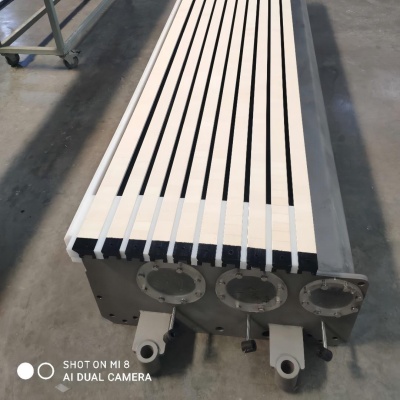
Paper two-sidedness is a common quality issue that can influence the performance and appearance of finished paper. Although the difference is observed between the two surfaces of the sheet, its causes can be linked to several stages of the papermaking process.
Fiber furnish, refining, wet-end chemistry, filler retention, sheet formation, dewatering and drying conditions can all influence how uniformly the paper structure develops.
For this reason, controlling two-sidedness requires more than adjusting a single piece of equipment. A better approach is to combine stock and chemical optimization with suitable forming and finishing technologies.
The distribution of fines and fillers through the thickness, or Z-direction, of the sheet is closely related to paper two-sidedness.
If excessive fines and fillers pass through the forming fabric during dewatering, the composition of the sheet can become less uniform.
Retention aids can increase the overall retention of these components while helping improve their distribution through the sheet thickness.
The source material specifically highlights the use of a dual-component microparticle retention system.
Compared with a conventional single-polymer retention system, this approach can provide better filler retention and a more uniform filler distribution. The source material reports that filler retention may increase by nearly 20% under the referenced conditions.
Fiber condition is another important part of the solution.
Proper refining promotes fiber fibrillation and increases the available bonding area between fibers.
This can contribute to better:
The fiber furnish should therefore be considered together with refining conditions when attempting to reduce differences between the two sides of the sheet.
For paper grades requiring more precise control of sheet properties, a Multi-Layer Headbox provides another technical route.
The principle is to create different fiber layers within the sheet and optimize the fiber characteristics of each layer separately.
For example, a selected surface layer may contain a higher proportion of fine fibers.
Instead of correcting the difference only after sheet formation, this approach uses the sheet structure itself to balance the properties of the two surfaces.
Because paper two-sidedness is fundamentally related to wet-web formation, the direction of dewatering is especially important.
A Gap Former allows the wet web to drain toward both sides during formation.
Compared with predominantly one-sided drainage, simultaneous two-sided dewatering reduces the structural difference created during the early stages of sheet formation.
Its primary purpose in two-sidedness control is to address the problem closer to its origin.
For an existing forming section, a Top-Wire Former provides another way to introduce two-sided drainage.
The additional top-side dewatering helps improve sheet formation and reduce structural differences between the two surfaces.
For Fourdrinier paper machines, this can be considered as an upgrade route when more balanced dewatering is required.
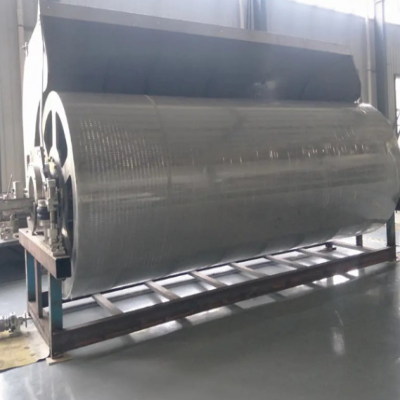
A Dandy Roll can be applied in the forming section to provide mechanical action to the developing wet web.
This promotes more uniform distribution of fibers and fillers and improves formation.
For existing paper machines where a complete forming-section rebuild is not planned, the Dandy Roll provides another method for influencing sheet structure during formation.
Controlling total filler addition alone may not be sufficient.
The source material recommends considering filler:
It specifically gives small-particle, spindle-shaped Precipitated Calcium Carbonate (PCC) as an example for promoting more uniform filler distribution.
Better distribution helps reduce composition differences through the sheet and between its two surfaces.
The forming section establishes the basic sheet structure, but inappropriate drying conditions can further increase two-sidedness.
Paper machine speed and drying capacity should therefore be properly matched.
Optimizing the dryer-cylinder temperature profile can prevent excessive differences in drying rate.
This is particularly important because uneven drying can increase stress differences and make existing sheet asymmetry more apparent.
Some remaining surface differences can be corrected later in the process.
The source material identifies Hot-Roll Calendering and Steam Box treatment as methods for balancing stresses and adjusting the properties of the two paper surfaces.
These technologies can contribute to:
However, they should be considered as complementary measures rather than replacements for correct wet-end and forming-section control.
| Technology | Process Area | Main Role in Two-Sidedness Control |
|---|---|---|
| Gap Former | Forming Section | Two-sided drainage reduces structural differences caused by one-sided dewatering |
| Top-Wire Former | Forming Section | Adds upward drainage and creates more balanced two-sided dewatering |
| Hot-Roll Calender / Steam Box | Calender / Dryer Section | Balances stresses and adjusts surface properties |
| Dual-Component Microparticle Retention System | Wet-End Chemistry | Improves Z-direction distribution of fillers and fines |
| Multi-Layer Headbox | Stock Delivery / Forming | Creates layered fiber structures to balance sheet properties |
| Dandy Roll | Forming Section | Improves formation and promotes more uniform fiber/filler distribution |
The source material emphasizes an important principle:
Paper two-sidedness should first be prevented during wet-web formation and then corrected through downstream processes where necessary.
From a long-term equipment perspective, Gap Formers and Top-Wire Formers provide a route toward more balanced two-sided dewatering.
For demanding paper grades, however, mechanical equipment should work together with chemical and process optimization.
A more complete improvement strategy therefore includes:
Retention Chemistry → Fiber Furnish & Refining → Headbox → Forming & Dewatering → Drying → Calendering
Combining these measures can improve the structural uniformity of the paper sheet and reduce property differences between its two surfaces.
Huatao Group provides paper machine equipment, components and spare parts for forming, dewatering, pressing and finishing applications.
Relevant products include:
For assistance with paper two-sidedness, sheet formation, dewatering performance or paper machine upgrade requirements, please contact Huatao Group.
Website: www.papermakingtech.com
Email: market@huataogroup.com
WhatsApp / WeChat: +86 180 3376 3037
#PaperTwoSidedness #PaperMachine #PaperIndustry #Papermaking #PulpAndPaper #PaperMill #PaperFormation #WetEndChemistry #RetentionAid #MicroparticleRetention #GapFormer #TopWireFormer #MultiLayerHeadbox #DandyRoll #DewateringElements #FillerRetention #Calendering #PaperQuality #PaperMachineUpgrade #HuataoGroup
can not be empty
can not be empty

HUATAO GROUP
ADD : No.298 Zhonghua North Street, Xinhua District, Shijiazhuang City, China.
TEL : +86 0311 80690567
EMAIL :market@huataogroup.com
Web: www.papermakingtech.com
Mobile: +86 18033763037 (  WhatsApp)