
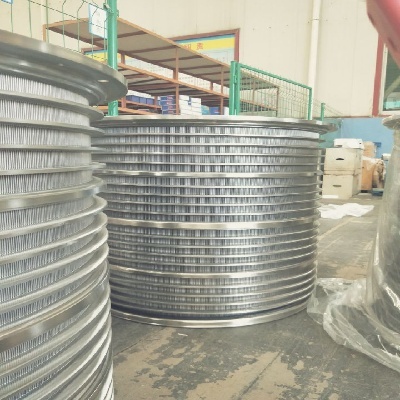
The screen basket is one of the key working components inside an approach flow pressure screen. Its opening geometry directly influences stock throughput, contaminant separation and operating stability.
For paper mills, however, selecting between a Hole Screen Basket and a Slotted Screen Basket should not be reduced to a simple comparison of opening sizes.
The two designs work differently.
A hole basket offers relatively high open area and throughput, while a slotted basket provides a different separation mechanism for stickies, plastic strings, fiber bundles and other elongated contaminants.
Understanding this difference is especially important in recycled-fiber and OCC-based paper production.
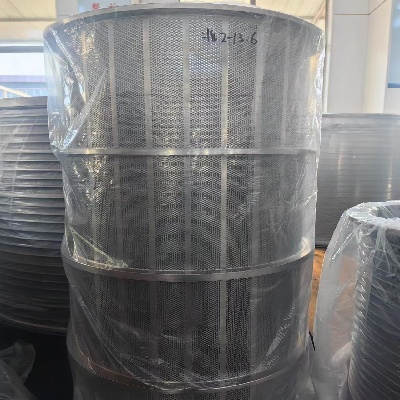
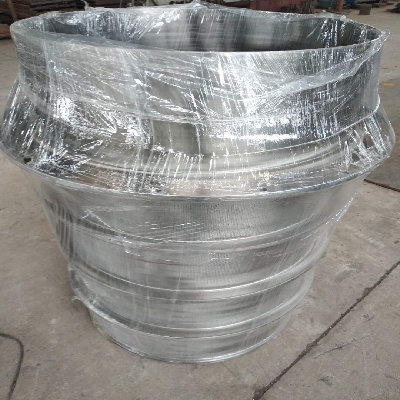
A Hole Screen Basket, also called a Perforated Screen Basket, consists of a screening surface with round through-holes.
For the first-stage approach flow application described in the source document, the typical hole diameter is:
Ø1.2–3.5 mm
These openings form cylindrical passages through the screening plate.
During operation, acceptable pulp fibers must orient themselves with the stock flow and pass through the round openings.
This design offers a significant advantage: high open area.
The source material gives an approximate open area of:
25%–30%
With the same effective basket area, this generally allows a perforated basket to handle a larger stock flow.
The basket structure is also relatively robust when exposed to larger contaminants, making it suitable for applications where throughput and mechanical durability are important.
The disadvantage becomes more apparent when the stock contains long, flexible contaminants.
Hot-melt adhesive strings, plastic strands and similar materials may enter the round openings depending on their orientation. Some can also become lodged inside the cylindrical passages.
Once this happens, the negative-pressure pulses generated by the pressure screen rotor may not always be sufficient to release the trapped contaminants.
As plugging gradually develops, the effective screening area can decrease.
The result may include:
For this reason, the contaminant profile should be carefully evaluated before selecting a perforated basket.
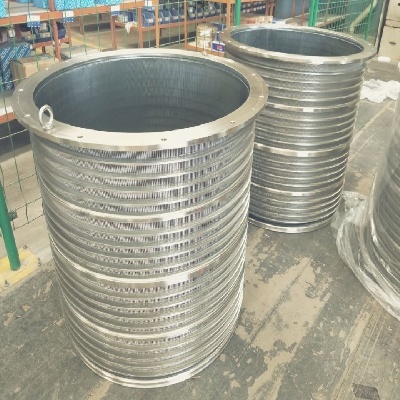
A Slotted Screen Basket uses long, narrow openings rather than round holes.
The design described in the source material uses V-shaped wedge wires, with a typical slot width of:
0.10–0.55 mm
The geometry is particularly important.
The opening is narrow at the screening surface and becomes wider toward the inside of the basket.
This means the slot does not behave like a small cylindrical hole.
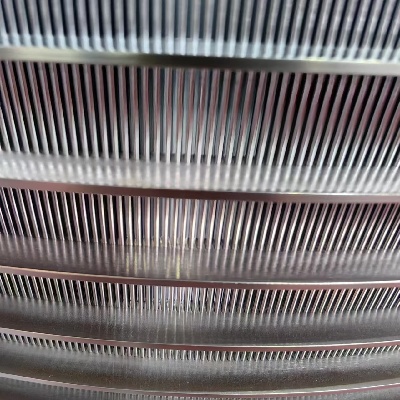
Pulp fibers are flexible and elongated. Under suitable flow conditions, acceptable fibers can align with the stock flow and pass through the slots.
Elongated contaminants have greater difficulty doing so.
Typical examples include:
These materials are more readily retained because they cannot easily pass transversely through the narrow slot opening.
This is one reason slotted baskets are particularly relevant for OCC recycled pulp and other recycled-fiber systems.
Another characteristic of the slotted basket is the widening internal passage.
Once material passes the narrow surface opening, more space becomes available behind it.
This reduces the possibility of material becoming tightly wedged inside the screening channel and gives the basket a degree of self-cleaning capability.
For stock containing troublesome elongated contaminants, this geometry provides a practical advantage over straight cylindrical openings.
A slotted basket also has limitations.
According to the source document, its typical open area is approximately:
7%–12%
Compared with the 25%–30% given for a perforated basket, this means a slotted basket of similar effective area generally handles a lower stock flow.
Other considerations include higher manufacturing cost and greater sensitivity to large hard contaminants.
If hard debris enters the pressure screen, the wedge-wire structure can be damaged or the slot geometry may become deformed.
Effective high-consistency cleaning and coarse screening upstream are therefore important when a slotted basket is selected.
The answer depends on the mill's production priorities.
A Hole Screen Basket may be more suitable when particulate and fragment-type contaminants dominate the stock and high throughput is the main requirement.
It can also be considered where the paper machine is operating close to full production capacity and sheet cleanliness requirements are moderate.
A Slotted Screen Basket, on the other hand, becomes more attractive when the furnish contains significant amounts of stickies, adhesive strings or plastics.
This is particularly relevant for OCC systems where mills want better control of sheet spots, contaminant-related paper breaks and paper machine runnability.
The choice can therefore be summarized as:
Hole Basket → Throughput + Particulate Contaminant Handling
Slotted Basket → Stickies Control + Elongated Contaminant Separation
Neither design is automatically superior. They are intended to solve different screening problems.
When a slotted basket is selected for the first-stage approach flow screen, fiber loss through the reject stream must also be considered.
The source document describes a practical arrangement used at some larger mill sites:
First-Stage Approach Flow Pressure Screen
Slotted basket for controlling stickies and elongated contaminants
↓
Second-Stage Screen
Recovery of acceptable fiber from first-stage rejects
This arrangement separates the two screening objectives.
The first stage focuses on contaminant control and paper quality, while the second stage helps recover usable fibers.
The overall objective is to achieve a better balance among:
Capacity + Fiber Yield + Paper Quality
One common mistake is to assume that the smallest possible slot provides the best performance.
In actual operation, reducing slot width excessively can create several problems.
Screening capacity can fall significantly, more usable fiber may leave with the rejects, differential pressure can remain high, and shutdown frequency may increase.
Therefore, slot width should be selected according to:
Furnish characteristics, contaminant type, production capacity and paper quality requirements.
A smaller slot is only beneficial when it matches the actual process requirement.
Another common assumption is that reducing the diameter of a perforated basket can make it equivalent to a slotted basket.
The source material indicates otherwise.
Fine and elongated adhesive contaminants can still enter round holes depending on their orientation.
At the same time, making cylindrical holes smaller can increase the risk of plugging.
Therefore:
A smaller hole does not reproduce the separation mechanism of a narrow slot.
This distinction is important when the objective is to control stickies and plastic strings rather than simply reject larger particulate contaminants.
Screen basket selection should begin by understanding what is actually entering the pressure screen.
For a first-stage approach flow application, the mill should evaluate the type of furnish, contaminant morphology, required production capacity, acceptable fiber loss and final paper quality.
Only then should hole diameter or slot width be determined.
The practical selection logic is:
Furnish → Contaminant Type → Screening Objective → Capacity → Fiber Yield → Paper Quality
When these factors are considered together, the pressure screen can perform its intended role more effectively without relying on unnecessarily small openings or excessive dilution water.
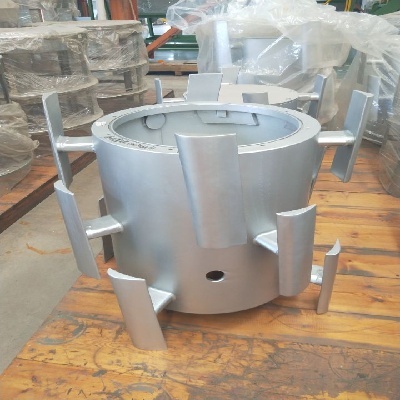
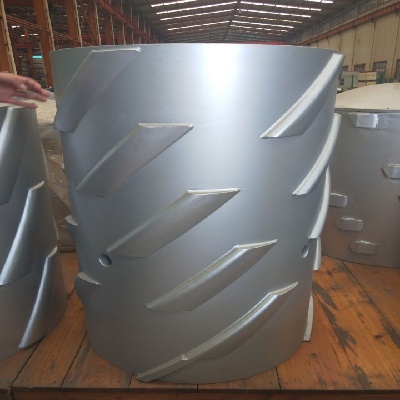
Huatao Group provides Hole Screen Baskets, Slotted Screen Baskets and related pressure screen components for pulp and paper applications.
Screen basket specifications can be selected according to pulp furnish, screening position, contaminant characteristics and production requirements.
For more information about pressure screen basket selection or approach flow screening applications, please contact:
Huatao Group
Website: www.papermakingtech.com
Email: market@huataogroup.com
WhatsApp / WeChat: +86 180 33763037
#HoleScreenBasket
#SlottedScreenBasket
#ScreenBasket
#PressureScreen
#ApproachFlowScreen
#ApproachFlowSystem
#PulpScreening
#OCCRecycling
#RecycledFiber
#StickiesRemoval
#StockPreparation
#PaperMachine
#PaperMachinery
#PaperMill
#PulpAndPaper
#PaperIndustry
#Papermaking
#PaperTechnology
#PulpEquipment
#HuataoGroup
can not be empty
can not be empty

HUATAO GROUP
ADD : No.298 Zhonghua North Street, Xinhua District, Shijiazhuang City, China.
TEL : +86 0311 80690567
EMAIL :market@huataogroup.com
Web: www.papermakingtech.com
Mobile: +86 18033763037 (  WhatsApp)